

Total Dynamic Functioning: Spontaneity, Ego, and the Paradox of "Crazy Wisdom"
- sensingradiance
- Jan 4
- 11 min read
I am from the unborn sphere of all phenomena. I consume concepts of duality as my diet. I act in the way of the Buddhas of the three times.
— Padmasambhava
This article examines spontaneity as a fundamental component of the awakening process. It further explores the interplay between intuition, ego, and discernment in teacher-student dynamics, and introduces the concept of crazy wisdom.
We often encounter the terms spontaneity, naturalness and effortlessness early on the path—perhaps as a pointing out instruction, or as experiential glimpses. Liberation seems to involve a specific sequence: spontaneous recognition, clarification, and the eventual dissolution of the identity structure. This is essential for the visceral realization of spontaneity and effortlessness, sometimes referred to as the natural state. Only when the illusion of individual agency collapses can this freedom become accessible.
Awakening (direct recognition) is purely spontaneous, and any experience contains the potential for recognition. In that sense, spontaneity is part of the journey from the beginning. But I do think it's healthy to be realistic, and understand that prior to the shift to nonduality the idea of spontaneous functioning—meaning, self-liberation—remains largely conceptual. To embody sheer spontaneity you need deep realization, ongoing commitment to the insight, and some good shadow work.
To quote an anonymous zen teacher:
Ultimately, spiritual realization is about living out of the innermost promptings of your tender and loving heart. However, without awakening you will think you are living out of the innermost promptings of your tender and loving heart, when in fact you will be living out of the outermost promptings of your deluded ego.

The Everything Machine
True spontaneity emerges from the discipline of clear seeing, deep intimacy with groundlessness (shunyata), and willingness to digest conditioning. It is characterized by otherworldly effortlessness, fluidity, and uncontrived presence. Dogen described this state famously as zenki: “total dynamic functioning” or “total exertion”.
This could be understood as a kind of “Everything Machine”: the wholehearted participation of the entire universe within a single, spontaneous action, without any sense of self. Here all things are seen and felt to be interconnected, functioning as seamless, interpenetrative whole.
Simply put, I don't think. I don't make choices or decisions. I don't weigh possibilities and select one over others. Instead, I observe patterns and move with them. (Jed McKenna)
Genuinely spontaneous actions are beneficial for all involved, facilitating harmony and alignment with the pattern of the whole. This natural movement may sometimes feel painful or disruptive, especially if we are holding onto toxic situations. Over time, these seemingly destructive experiences can be recognized as deeply transformational and intelligent, generating growth, purpose and resilience.
Total participation often comes with a tangible sense of natural release and renewal—enhanced vividness, clarity, and natural bliss. Illusions are revealed and dismantled with transcendental efficacy. The ensuing vulnerability is redemptive, culminating in a pervasive sense of peace and universal connectivity. This way of living feels both impersonal and radically intimate.

Spontaneity in Nondual Traditions
In Dzogchen lhundrup (spontaneous presence) refers to the self-cognizant nature that is open and immediately present, not created through effort. The emphasis is on direct recognition and abiding without contrivance, which leads to spontaneous responsiveness and release.
In Zen, the use of koans are designed to exhaust rational thought and crack the analytical mind, unleashing an explosion of intuitive breakthrough. Spontaneity in this context is the unobstructed functioning of mushin (no-mind) that is open, receptive, and not fixed. In mushin, action is instinctual, emerging from deep training and experience, without hesitation, self-consciousness, or calculation.
Spontaneity in Taoism, rooted in the concept of ziran ("spontaneously self-so") is a state of being true to one's original, self-generating nature, free from contrived desires or external coercion. Embracing ziran involves simplicity and letting go of artificial adornments, allowing one's actions to flow naturally, much like breathing. This is closely associated with wu wei ("non-action”, “effortless action”), a mode of being that brings alignment with ziran.
In Kashmir Shaivism, spontaneity is central to its core principles of pratyabhijñā (spontaneous recognition) and spanda (divine pulsation). It is also associated with anupāya, the "path without means", which is similar to the Dzogchen paradox of no path. Reality is here characterized by incessant, gushing freshness, a continuous process of spontaneous self-renewal.

Spontaneity vs Impulsivity
Whereas genuine spontaneity is selfless, impulsivity is often selfish, and an expression of psychological immaturity. It´s a form of unconscious shadow possession: a tendency to react quickly without thinking, driven by repressed emotions, uncontrolled desires and fears, or emotional habits.
Spontaneous activity is inseparable from absolute stillness. That makes it a very different experience from mere impulsivity which is characterized by recklessness, lack of self-awareness, and unconscious fear. Impulsivity results in arbitrary, hasty actions, thrill of risk (often mistaken for freedom), and an immediate neurochmical reward of dopamine/adrenaline rush, disregarding potential negative consequences for self or others.
True spontaneity is attuned with the natural order of things, it directly engages with the energetics of the situation and assimilates the experience fully. In contrast, impulsive actions are blind to the underlying energetic patterns. They bind us deeper into conditioning and reactivity, and often facilitate disharmony and suffering for self or others.

The Shadow of Deception
As long as we are under the illusion of self, we see others largely through projections. We may idealize a charismatic teacher/guru and see their actions as divine and spontaneous, even when they act from egoic motivations. Likewise, we may be unable to recognize a genuinely realized teacher because our mind is clouded by preconceived notions, and they don't fit our ideas about awakening.
You may be asking, how can we know if a teacher is acting from a place beyond personal self? The common advice is to trust your intuition and gut sense—but this advice comes with a warning, as the ego tends to be elusive. Unresolved trauma and the intellectual alienation of our modern world often results in disconnection from the gut sense, amplifying identification with the wounded parts of the psyche. This makes it difficult to differentiate between intuitive “knowing” and conditioned patterns.
The lack of discernment may manifest as an intense attachment and loyalty to people who are not healthy to us, appearing as a sense of deep connection. It may say: “Despite really knowing them, I trust this person completely. The connection feels magnetic and blissful, igniting a sense of deep devotion. I feel seen in a way I have never felt before. This must be intuition.”
It may manifest as fear of genuine connection and vulnerability, and say: "I deeply distrust this individual. They challenge my core beliefs about myself, they are straightforward and unpretentious, which makes me feel very uneasy. I can't figure them out, I can't influence them, and that lack of control feels dangerous. I'm convinced this is my gut instinct trying to protect me."
How to stay safe when we are wired for being misled? This is one of the dilemmas I have personally no answer to. Intuition is crucial, but obscured by karmic compulsion and unresolved trauma. These blockages hinder natural functioning, preventing clear perception and effective action. Consequently, we often remain blind to the truly liberating choices until awakening occurs.
Paradoxically, it is only pure spontaneity that can penetrate the mechanical, repetitive loops of the egoic prison, and thoroughly shake the foundations of the constructed self. This event is, of course, awakening.

Pitfalls, Betrayals, and Breaking Free
How do we know if a teacher is true or false? I would say cultivate healthy skepticism, but stay open for potential guidance. Trust your innate capacity to wake up. You are the sole arbiter of your experience; never relinquish your autonomy to another person and give them the power to dictate your reality or determine your self-worth.
The core function of a teacher is to support, challenge and empower someone in the process of awakening, not to comfort them or simply provide answers. They encourage you to confront your fear and question all beliefs, fostering critical thinking and experiential insight. They help to illuminate unexamined assumptions and biases, and empower autonomy, pointing out our innate capacity for direct recognition and self-liberation. They must have made the journey firsthand, and continue to refine and deepen their experience and understanding, to qualify as an awakening guide.
If you struggle with childhood wounding, be aware that it comes with a tendency to re-create the pattern of the core trauma and re-live the unhealthy relational dynamics. Finding a skillful therapist or shadow work modality to integrate this part of the psyche is recommended. Spiritual communities are often not a safe place to do this type of work, unless the teacher is trained and specialized in deep shadow work.
Be aware of false guides who masquerade as spiritual authorities; no matter how impressive their knowledge, intellectual expertise and charisma seems, if they don't demonstrate the signs of living realization and capacity to guide others towards the suffering in direct experience, they are simply useless (and often misleading) as awakening guides.
Ultimately, we cannot control whether a teacher turns out to be trustworthy or not. However, every obstacle—even the pain of betrayal—can become a portal for transformation. What feels like a betrayal may actually be a karmic initiation, serving as a profound teaching on love, illusion, and the nature of the ego. Rather than seeing a teacher's failure as a dead end, we can experience it as a form of wrathful compassion. Digesting this experience becomes the fuel to deepen bodhicitta, forging a more ruthless compassion and a renewal of our commitment to liberation.
When we connect with a genuine teacher, we feel drawn to their authenticity rather than their personality. They directly mirror our own uncontrived nature. On a deeper level, we fall in love with the basic, unmanipulated ground of being. We fall in love with the unknown. We can drop the pretense, there are no power games. While this mirroring can trigger uncomfortable or unexpected emotions, we learn to value that growth. A true teacher is irresistible because they cannot be manipulated; the interaction maintains a truthful, revitalizing impact, even when it appears challenging.
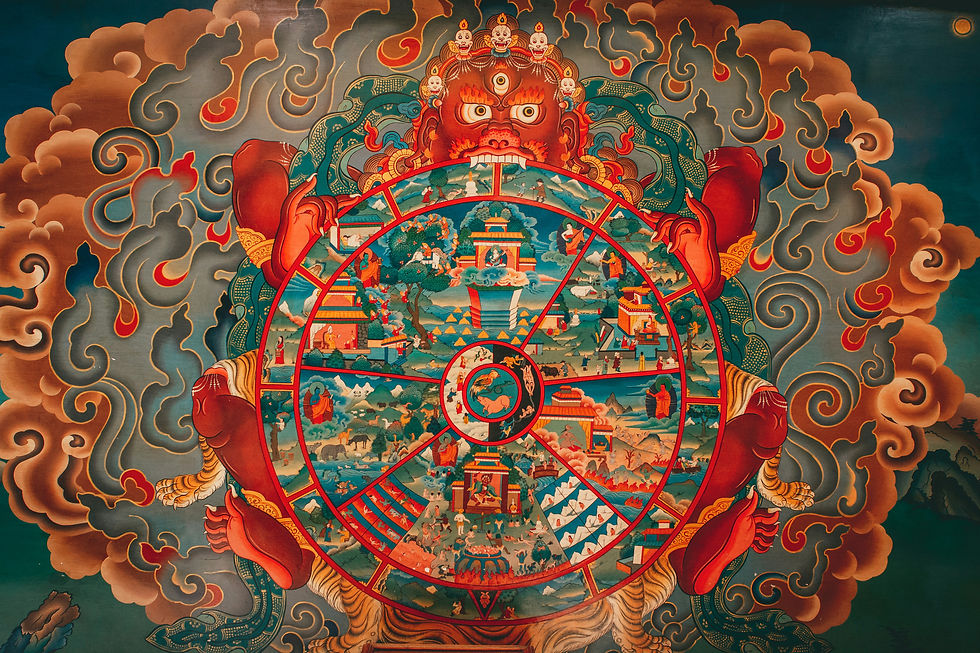
The Chaos of Primordial Wisdom
We now turn to the controversial concept known as crazy wisdom.
Spontaneity is considered an essential characteristic and expression of crazy wisdom, or yeshe cholwa—yeshe meaning “wisdom that has always been present, untouched by concepts“, and cholwa meaning “wild or uncontainable.” This is the natural, uncalculated way an awakened mind operates. The term can also be used to refer to someone who appears to be drunk with boundless, radiant, otherworldly joy. What we call crazy is only crazy from the perspective of ego and societal norms; the perceived madness is truly just intense delight and sharp insight.
Crazy wisdom characters are archetypal figures embodying spiritual insights through unconventional or seemingly irrational behavior. Their actions are trans-rational, they operate beyond conventional logic to challenge norms and stimulate awakening. A crazy wisdom person basically acts as a mirror that reflects a person's neurosis back to them abruptly and directly, without compromise or premeditation.
They laugh at our self deceptions and question our cherished beliefs, illuminating the Great Cosmic Joke. This wisdom laughs not with malice, but with compassion for the suffering that results from rigid beliefs and unconscious attachments. Figures associated with crazy wisdom often use humor or outrageous behavior to expose hypocrisy, collective lies, and religious dogma, demanding an end to injustice.
In the scriptures, a crazy-wisdom person is described as “He who subdues whatever needs to be subdued and destroys whatever needs to be destroyed.” Whatever your neurosis demands, when you relate with a crazy-wisdom person, you get hit with that. Crazy wisdom presents you with a mirror reflection. A mirror will not compromise with you. If you don’t like what you see, there’s no point in blaming the mirror. (Chögyam Trungpa)
This raw clarity can be startling, but arises from profound stillness and insight. It is as rare as a diamond; if you experience even a flash of it, count yourself fortunate. Since my first encounter with it, I have been haunted by a strange, undeniable sense of homecoming. Sometimes it feels as though multiple dreamlike, simultaneous realities overlap, shift and quickly dissolve, leaving behind a taste of sweet sadness. Ungraspable, this emptiness dancing appears as these words that I find myself writing here.
The following is a summary of authentic crazy wisdom's key elements. The purpose is not to romanticize this paradoxical phenomenon or excuse its misuse by abusive gurus. The intention is to capture a flavor of the radical fearlessness that makes this “chaos of primordial wisdom” so compelling.

Innocence and primordial freshness: Crazy wisdom is an innocent state of mind that operates without the baggage of preconceptions. It cuts through pretense and engages with reality directly, much like a child. It has the atmosphere of blazing aliveness and radical sobriety, even when it appears intoxicated with joy (or substances).
Transcendence of convention: The behavior appears crazy because it is not bound by ordinary reference points. It functions outside the boundaries of societal norms, conventional morality, and consensus patterns, going against the stream, freeing the mind from rigid spiritual or philosophical restrictions.
Perceptiveness and Precision: Rather than being random or haphazard, this spontaneity is characterized by absolute perceptiveness, with fearlessness and bluntness. It involves a quick precision and a complete dance with the situation at hand, without hesitation.
Complete directness: It relates directly to the mind of enlightenment without relying on conventional rules, gradual steps, or intellectual constructs. This directness allows for actions that are unforced and naturally appropriate to the moment.
Basic Sanity: Arises from an intimate attunement and trust in the natural functioning of reality (shunyata). It is not something an ego can co-opt for immature acts of rebellion.
Utterly hopeless: True spontaneity appears when we give up hope for a comfortable answer to pain or confusion. By letting go of the need for a predictable spiritual path, crazy wisdom introduces the raw, fresh quality of sheer aliveness.
Embracing pain: Instead of seeking comfort and safety, we turn towards painful emotions as invitations for liberation, a hallmark of crazy wisdom's direct approach.
Egolessness & tenderness: Authentic crazy wisdom is an expression of deep intimacy with reality. It generates genuine connection and insight, rather than pure shock, if you are willing to stay in direct contact with the experience.
Bravery to be a fool: Spontaneity requires a specific type of bravery—the willingness to be a fool and make mistakes. This openness allows for a childlike freedom and otherworldly joy that counters the rigidity of social rules and learned behaviors.
Radical fearlessness: A person exhibiting crazy wisdom is completely fearless in engaging with the world of confusion, transcending the attachment to nirvana and the aversion to samsara.
Authentic & purposeful: The behavior isn't chaotic; it's a strategic tool to dismantle attachment, spiritual ego, and rigid concepts of "holy" or "unholy".
Holy Fool archetype: Embodies figures like zen master, poet, avadhūta, jester, shaman, or siddha, who operate outside norms and use radical methods to cut through spiritual complacency, similar to Christian Fools for Christ, or Sufi mystics.
Distinction from "just crazy": Crazy wisdom is purposeful, rooted in the presence of genuine, beneficial wisdom, it aims to liberate; it's distinct from mere mental illness, destructive behavior, or manipulative cult leadership (though it can be misunderstood as such). It often comes with a high degree of conscious control and discernment, even when the behavior appears strange or unconventional to outsiders. The individual can function in society when needed, and their ecstatic, trans-rational behavior functions as a conscious “skillful means”.

Conclusion
Is the kind of sheer spontaneity characteristic to deep realization truly possible? The paradox is that this enlightened reality—actionless action—natural self-liberation—is purely subjective experience that simply cannot be proved or demonstrated.
It´s obviously nothing the mind conceives, projects, or imagines it to be. There is nothing particularly spiritual or exalted about this state. This is not a perfected mode of being in which no human mistakes are possible, or in which one is immune to pain. It does not mean that no conditioning or egoic tendency ever arises, or that all traumas and past wounding are erased. That kind of freedom is a myth.
Ultimately, the natural state is so all-encompassing that everything appears as spontaneous, vivid expression of nothing—even the apparent obscurations. All distinctions collapse in magnificent sameness. Absent yet appearing; this is the absolute view. This stunning unknowability.
But from the relative standpoint, there is an act of endless refinement in which the remnants of karmic patterns that obstruct natural functioning are meticulously examined, chewed, digested. It's just happening—this is the invisible way liberation “moves” … with nothing actually happening at all.
Is liberation possible? Find out for yourself. Just be warned—this freedom takes everything. It comes with a sacrifice. What that means cannot be explained in any satisfactory manner.


